Stainless steel is available in many different grades, each designed to provide a different balance of corrosion resistance, mechanical properties, formability, weldability, and cost. Selecting the right grade depends on the product design and, more importantly, the environment in which the product will be used.
Stainless Steel 316 / 316L
316 stainless steel offers excellent corrosion resistance and performs particularly well in more demanding environments. The addition of molybdenum improves its resistance to localized corrosion caused by chlorides, making it a common choice for marine, chemical, pharmaceutical, food-processing, and other applications where greater corrosion resistance is required.
316L is the low-carbon version of 316 and is particularly suitable for applications involving extensive welding.
Best suited for: demanding or corrosive environments, chloride exposure, marine applications, chemical processing, pharmaceutical equipment, and selected food-processing equipment.
Stainless Steel 304 / 304L
304 is one of the most widely used stainless steel grades and is often considered a general-purpose stainless steel. It provides a well-balanced combination of corrosion resistance, formability, weldability, appearance, and cost.
Because of its versatility, 304 is commonly used for kitchen equipment, food-related products, shelving, sinks, household appliances, storage equipment, and many other indoor and outdoor applications.
304L is the low-carbon version of 304 and provides advantages for welded structures where resistance to intergranular corrosion is important.
Best suited for: kitchen equipment, food-related products, shelving, sinks, household products, and general-purpose applications requiring good corrosion resistance.
Stainless Steel 430
430 is a ferritic stainless steel commonly selected when a more economical material is required. It offers moderate corrosion resistance and is widely used in indoor or mildly corrosive environments.
Unlike 304 and 316, 430 does not rely on a significant nickel addition, which can make its material cost less sensitive to fluctuations in nickel prices. However, its corrosion resistance is lower than that of 304 and 316, particularly in environments involving salt, chlorides, high humidity, or aggressive cleaning chemicals.
430 is also normally magnetic, which is a characteristic of its ferritic structure.
Best suited for: indoor kitchen equipment, household appliances, panels, decorative components, shelving, and other applications with limited exposure to corrosive environments.
Stainless Steel 201
201 is a low-nickel austenitic stainless steel in which manganese replaces part of the nickel normally found in conventional chromium-nickel stainless steels.
It can provide good strength and formability while offering a more economical material option. Its corrosion resistance, however, is generally below that of conventional 304 stainless steel, so the operating environment should be carefully considered before using it as a substitute.
Best suited for: household appliances, kitchen utensils, sinks, doors, windows, and selected indoor products.
Stainless Steel 410
410 belongs to the martensitic stainless steel family. Compared with common austenitic grades such as 304 and 316, it is selected more for its ability to be hardened and for its mechanical properties than for maximum corrosion resistance.
Best suited for: valves, shafts, pump components, mechanical parts, and applications requiring higher strength or hardness.
Stainless Steel 420
420 is another martensitic stainless steel with higher hardness capability. It is commonly used where cutting performance, wear resistance, and mechanical strength are important.
Best suited for: knives, cutting utensils, surgical instruments, mechanical components, and wear-resistant parts.
How Do 316, 304, and 430 Compare?
For general corrosion resistance, the three commonly used grades can broadly be considered in the following order:
316 → 304 → 430
316 provides greater protection in demanding and chloride-containing environments, while 304 offers an excellent balance for general-purpose applications. 430 provides a more economical solution for applications where the corrosion environment is relatively mild.
The material cost generally follows a similar pattern, with 316 typically being more expensive than 304, and 430 often providing the more economical option. However, actual pricing can vary depending on alloy market prices, material thickness, surface finish, quantity, specifications, and other commercial factors.
Choosing the Right Stainless Steel
Choosing stainless steel should not be based on price or grade number alone. Important factors include moisture, humidity, chloride or salt exposure, cleaning chemicals, operating temperature, welding requirements, surface finish, mechanical strength, product life expectancy, and target cost.
Our team can evaluate these factors together with your product requirements and recommend a suitable stainless steel grade for both performance and cost effectiveness.
We do not claim to be the lowest-cost supplier in the market. Suppliers in countries with lower material or labor costs may sometimes offer lower unit prices for high-volume orders.
However, CHAO YUON provides a different value: flexible production, stable quality, a broad range of wire shelving products, and more than 30 years of manufacturing experience in Taiwan.
We support both standard products and customized OEM / ODM requirements in various sizes and order quantities. Compared with highly automated factories that mainly focus on very large production runs, our production setup allows us to respond more flexibly to product adjustments, mixed orders, and customer-specific requirements.
We also support quality management and customer audit requirements, including third-party or customer-specific audits such as Costco COC. This helps customers build a more reliable and transparent supply chain.
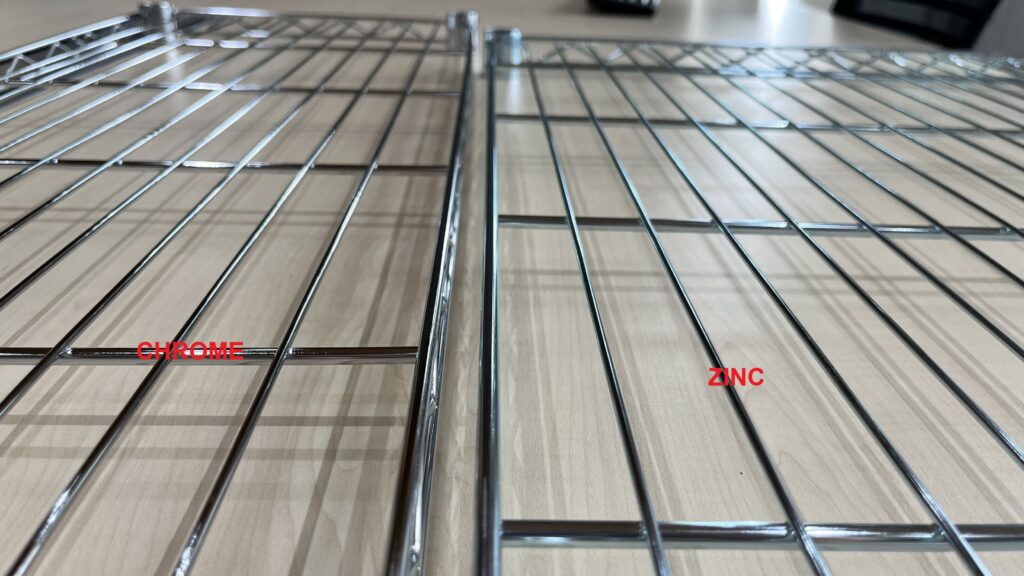
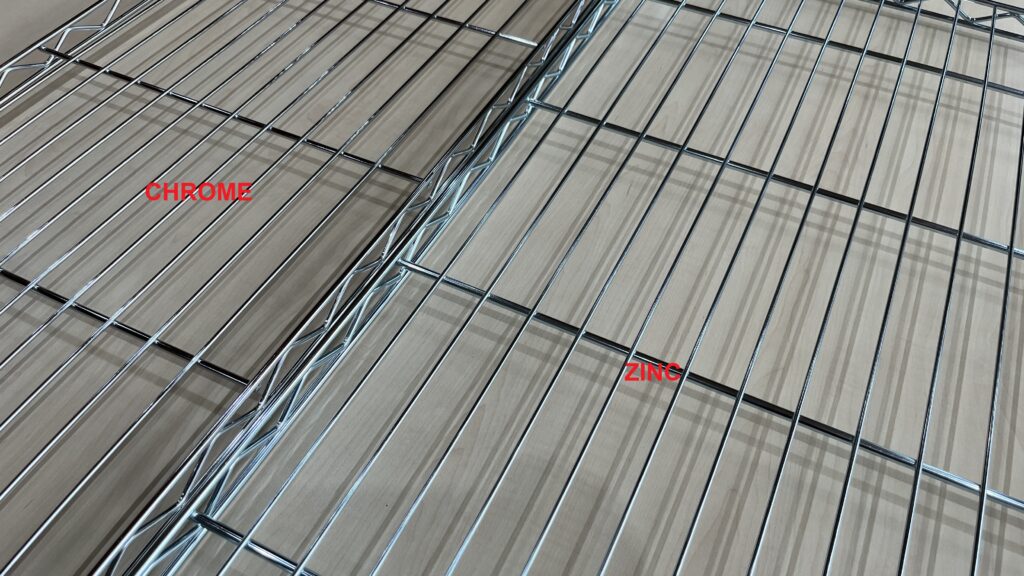
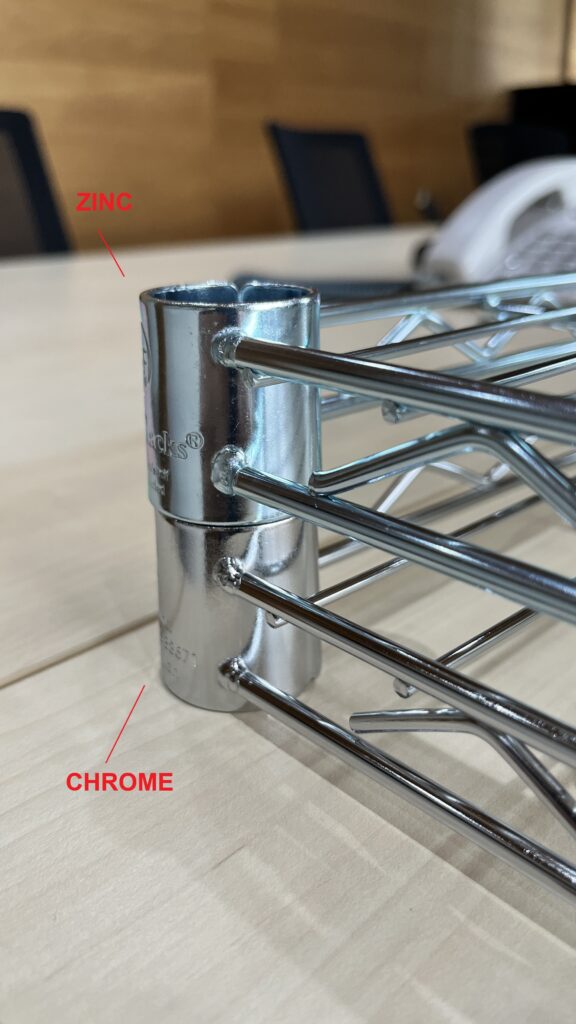
Zinc plating and chrome plating can look similar, especially when viewed separately. Both finishes may provide a shiny metallic appearance, but they differ in visual tone, corrosion performance, and cost.
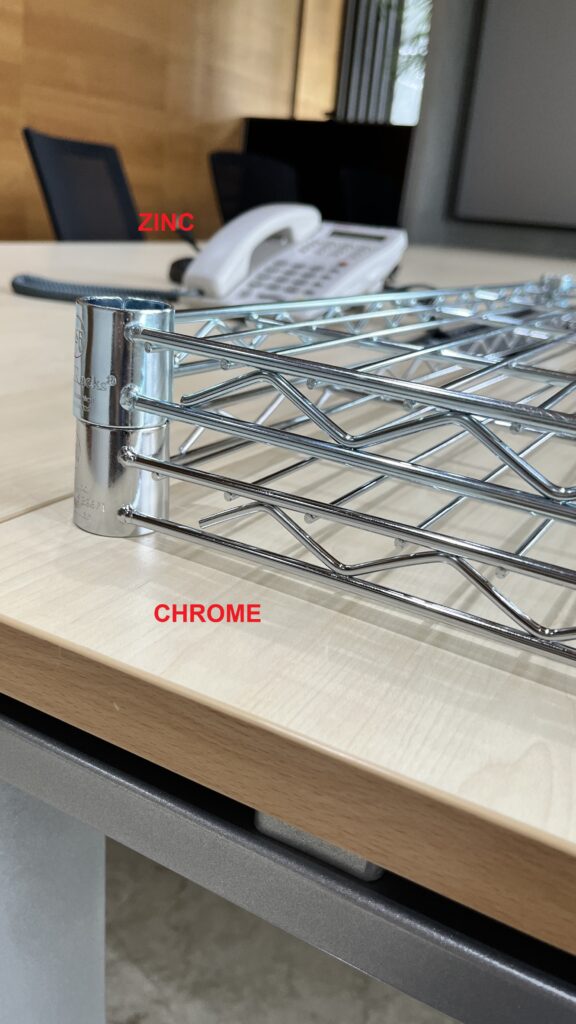
Chrome plating usually has a brighter and more mirror-like finish, making it suitable for products that require a clean decorative appearance.
Zinc plating may appear slightly different when compared side by side with chrome. Over time, oxidation may form a protective layer on the zinc surface, which can make the finish look more matte while helping improve corrosion and rust resistance.
Because the final appearance may vary depending on the plating process and supplier, we recommend comparing physical samples when finish consistency is important.
Zinc plating can look shiny, but it is generally not identical to chrome plating.
Chrome plating usually appears brighter and more reflective, while zinc plating may become slightly more matte over time due to surface oxidation. This oxidation can help provide additional corrosion and rust resistance.
In product photos, both zinc and chrome finishes may appear shiny. However, customers may still notice differences in brightness, tone, and surface appearance when comparing physical samples side by side.
Yes. CHAO YUON provides OEM / ODM manufacturing services for metal storage products, wire shelving systems, utility carts, folding carts, wire baskets, and customized metal products.
Customers may provide drawings, samples, reference products, or initial product ideas. Our team can support product evaluation, structure improvement, material selection, sample development, production planning, packaging review, and export preparation.
CHAO YUON manufactures a wide range of metal storage and cart products, including wire shelving systems, storage racks, utility carts, folding carts, wire baskets, casters and wheels, and customized OEM / ODM products.
Our products are used in home storage, commercial organization, retail display, warehouse storage, kitchen and pantry storage, garment storage, and other professional applications.
Yes. We can support customized sizes, structures, materials, surface finishes, packaging methods, and product specifications based on customer requirements.
Available surface finishes may include chrome plating, zinc plating, powder coating, and other project-specific finishes. Final options may depend on product structure, material, order quantity, target market, and production feasibility.
We can support customers with quality, compliance, and audit-related documentation based on product type, material, surface treatment, and target market requirements.
Available support may include ISO 9001, NSF, REACH, RoHS, TSCA, California Proposition 65, Costco COC, Costco GMP, FSC, ISTA-related packaging tests, TÜV Rheinland-related reports, and customer-specific compliance documents.
Document availability may vary depending on the product category and project requirements. Please contact our sales team for project-specific confirmation.
Customers can start by sending us product drawings, samples, photos, reference products, target specifications, packaging requirements, estimated order quantity, and destination market information.
After receiving the project details, our team will review the product structure, material requirements, manufacturing feasibility, surface finishing options, packaging method, and export preparation needs. We will then provide feedback, suggestions, and quotation support based on the project scope.